
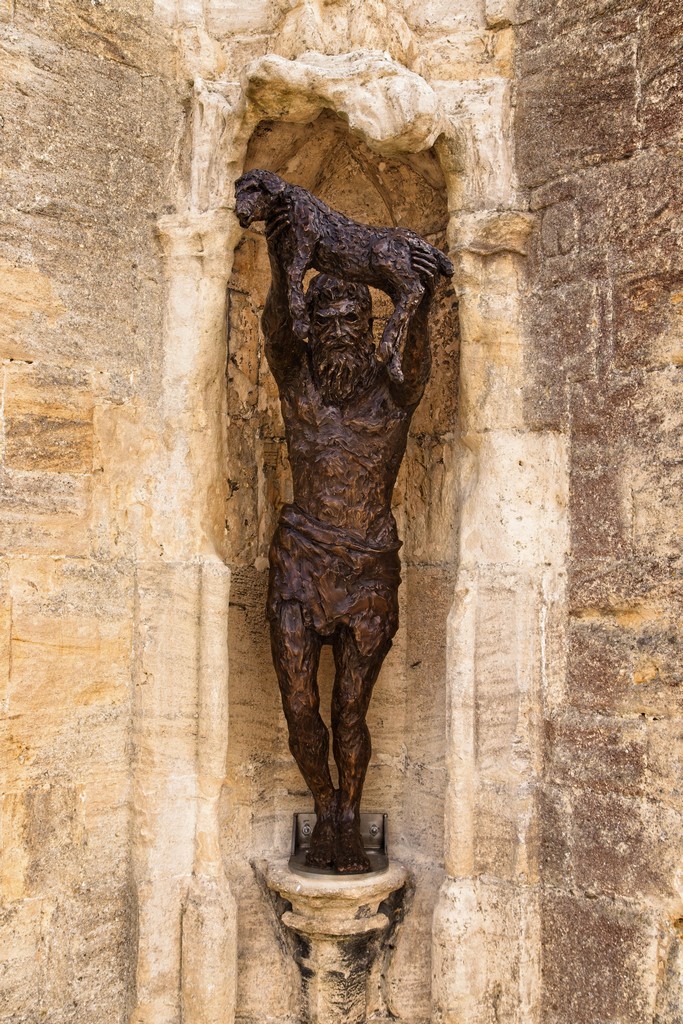
A project to replace the statues in the southwest and northwest Tower niches culminated in 2021 after three years of planning. Canon Graham Morris said: “It’s fantastic that we have this exciting project helping to re-establish what was a key feature in Cirencester.”
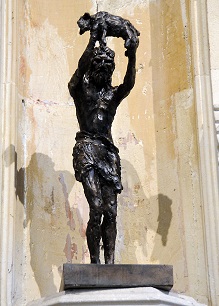
The statues were removed from the tower of the Church of St John Baptist in Cirencester, Gloucestershire, in 1963 due to safety concerns and disappeared. Meg Blumsom of Project Blackjack said the original St John the Baptist statue “had a special place in the hearts of the people of Cirencester” as it allegedly gave its name to a nearby street. The statue was blackened from soot used in coal fires during the 1700s and was nicknamed “Black Jack”. The niche the statue was in faces a narrow street formerly known as St John Street, but the name was changed in 1877 to Black Jack Street.
Ms Blumsom described its disappearance as “a mystery that’s puzzled the church for more than 50 years”.
The project was funded by grants and donations, from local organisations and philanthropists.
Rodney Munday was selected to design and sculpt the statues which were in place by the Summer of 2021 with the blessing of the Statues by Bishop Rachel on September 5th. He said:
“I am proud to have been chosen to take this project forward. My original aim was:
- To make a statement about the relevance that St. John the Baptist and the Virgin Mary have within the context of contemporary Christianity, in order to affirm the understanding that the Parish Church stands at the spiritual heart of the community.
2. To produce contemporary works that are visually interesting, but do not jar with the ancient structure of the church. The sculpture should appear to be a natural part of that structure, to which they would be both subservient and complementary.
My original idea for St John changed following my visits to Cirencester. Originally, I proposed that I would depict the Baptist as a harsh figure of a man; the last of the Old Testament prophets who brought a message of destruction as the consequence of man’s sin; a representation of a contrast between the Old and New Testaments, between which John forms a bridge. I envisaged him holding a cross which would prefigure the crucifixion, and link him to the sculpture of the Virgin and Child.
With the passage of time, I felt that although the image could be an impressive and relevant one, I was finding it difficult to relate personally to this figure of John, and I expressed my difficulty to Canon Morris. In discussion, he told me that he saw that John was not important to himself, but saw himself as an intermediary revealing a future.
Subsequently members of the congregation pointed out the John Baptist window, depicting the Baptist holding a lamb, the only image I have seen of him doing so as a man, and it was suggested that the lamb might have been included because of the importance of the wool trade to the town.
Following these conversations, I rethought my representation, and John now holds out a lamb – the Lamb of God – over the town and over the people into which he is looking. For me, this is a more relevant link to the New Testament, and I am happy that it also refers back to Cirencester’s past, and its present within a farmed countryside.
I believe that linking the religious and lay contexts of a location is important in bringing the whole community together; and I am minded of the Eucharist I attended on one of my visits to Cirencester, when the door of the church was left wide open, and I felt that it symbolised the way the church invited and embraced the town.
It seems to me that representations of Mary also inevitably pose some problems within the Protestant tradition. Her role as a mediator between man and God, once so important within the Roman Catholic tradition, raises difficulties. At the same time, a simple image of a mother and child can easily become one that might be any mother with any child, or at worst be sentimentalised.
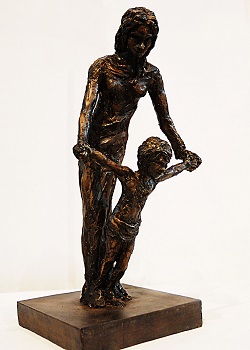
In order to address these problems, I envisaged the Virgin holding a standing Christ-child by both hands, as he leans out of the niche in a position typical of a child’s curiosity and fearlessness, whilst at the same time being suggestive of his crucifixion. As Mary holds him, the sculpture is both Madonna and Child, and Pieta, looking beyond Christ’s childhood to a future where Mary bears his body after the descent from the cross. The sculpture would have the timeless relevance of depicting the important, if difficult fact, that the way of Christ is the way of the cross.
The statues were cast in bronze, a change from the earlier stone versions, but this reflects changing needs and technology. Vicar, Canon Graham Morris said ” We look forward to these statues lasting for another 600 years, gracing the church and the Market Place”
..